

This year the European Central Bank has been holding a public vote on the newest euro banknote design. This is the first full redesign since 2002, after nearly 25 years. You can also vote on how the new banknotes will look; however, this voting process is not solely for democratic purposes, and the timing is rather worth questioning. The main goal of this redesign project is probably not what you think, though. In this article we will find out how this process will work out for you and for the world economy, in some ways.
You’ve probably seen the proposed design for the cash banknotes you carry every day on social media. Have you ever thought about what would be the main motivation to change the art style of the Euro? Because it’s not something that happens regularly, is it? I talked about the change in our money in this blog before. All the major economies in the world now are pushing for a change that, for some, would revolutionize our payment systems. Since the EU is the biggest economic alliance in the world, it also became the pioneer of this change. And that is the full digitization of money. At this point, you might think that we are already in a fully digitalized world, and you wouldn’t be all wrong. However, the Central Bank Digital Currency (CBDC) is usually misunderstood since it’s quite a new concept. You can find more about CBDCs on my blog, but I will make a quick summary for you.
The Quiet Progress—Digital Euro
It all started from an increasing demand from the public for a safe and trusted electronic payment method. So the EU launched an investigation phase toward such a system. As we talked about it before on my blog, digital fund transfer systems by banks might lack trust and carry risks for the public and businesses. Therefore, banks might face risky scenarios that harm consumers if not properly managed. Because a bank is a commercial company that might fail. And if it fails, all the consumers’ deposits would go down with it. At that point, a stronger entity would have to step in to fix the order, like it happened quite a few times before. Eventually, the idea of Central Bank Digital Currency (CBDC) was born from the idea that a central bank can be the main operator for those transactions. Such a digital currency can be understood as money offered in digital form for use by citizens and businesses for their payments.

Eventually, the EU has to decide whether or not to issue a digital form of the euro. But it requires a whole process of proposal, approval, and regulation to establish a legal framework. Thus, the EU put forward a digital euro package on 28 June 2023. The digital euro would establish a digital form of central bank money, alongside the euro cash and coins, of course. This sentence is crucial for our thesis, since we’ll indicate digital euro’s impact besides its technicality.
After that, the European Central Bank concluded the preparation phase for the digital euro. While implementing this process, the ECB worked hard to figure out how to integrate the digital euro into the broader payments ecosystem. You can find all the outcomes from this phase in the well-prepared report of the ECB at the very end of this article. But I will pinpoint key outcomes for you.
Why Do We Need the Digital Euro?
The report found out that one of the main drivers for acceptance of a payment method by small merchants was customer preference and low fees. Also, the greatest concern among the small merchants is the security issues related to payment systems. So they crave a payment system that saves them from various operational risks. Such as technical malfunctioning, high fees, and administrative burden. On the other hand, the report suggests that consumers value security, ease of use, reliability, and control of their payments. However, key pain points mentioned included concerns about theft, loss, and fraud among the consumers. Those can vary from occasional refusal of cash and card payments by merchants, usability issues, and technical & system failures. Although consumers in this research are generally satisfied with their current payment methods, they expressed an interest in new payment methods, especially the ones that can cure their key pain points.
So, the ECB came up with solutions that would fix most of those issues. Such as the offline functionality that would allow payments to take place even without a network connection. The report suggests that the majority of the merchants found this statement very important for their operations, especially the ones in rural areas where the network outages happen more often. Also, another statement says that digital euro will reduce the costs for merchants and give them more bargaining power by increasing competition. Which merchants mark this function as very important as well. Overall, the report expects that the digital euro will strengthen the European economy by making Europe’s payment systems stronger, more trustworthy, and more innovative.
Banknote Redesign
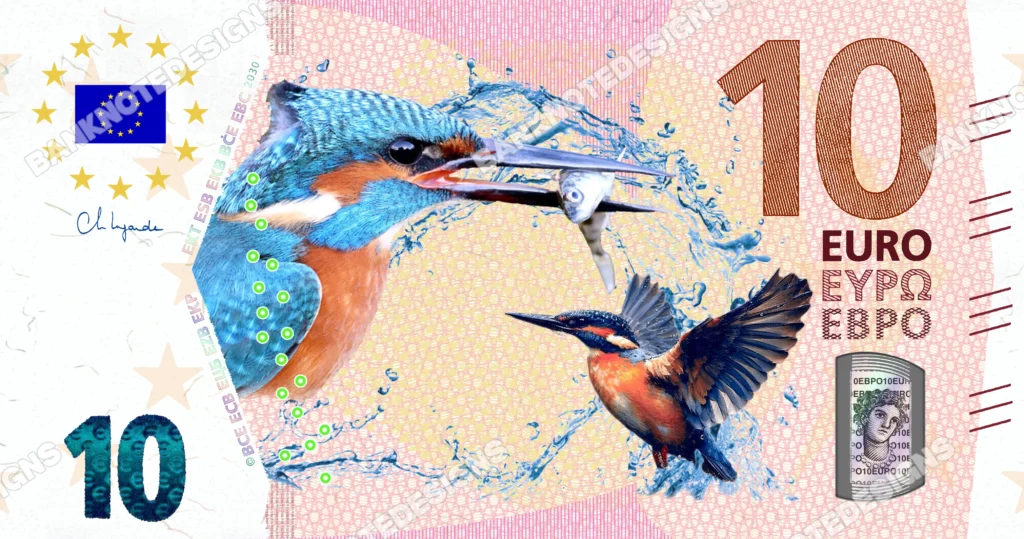
We have come to the last phase of the redesign process by now. After a couple of years of the initial survey, the only thing left is to decide which design should be added to the circulation. However, it will take several years before the newly designed banknotes find their way into our pockets. You can join a survey by clicking here to choose one of ten proposed designs to be your next banknotes. After you submit your vote, you will face a statement that says, “…a decision will be made about when to introduce a new series of euro banknotes—a pivotal step that underlines the European Central Bank’s commitment to cash.” One reading of this statement is that the ECB’s focus is to complement the cash, not to displace it with a digital version of it.
What’s Next?
We’ve talked about two different proposals by the same institution in the same year. Eurosystem has proven its strength and trustworthiness in the last 24 years. The EU must have found it necessary to refresh its currency to reflect the innovation while securing that trustworthiness. It seems that the coincidence in those two actions might not be that absurd since both proposals share the same root, modernization, security, and public trust in the euro. However, those two changes might not be that correlated. Since the EU is a big and complex structure that has years-long legislative processes on a variety of issues for the future of the whole continent.
The new design of the euro banknotes will be finalized by the end of this year. Around the year 2029, these new designs will replace most of our current banknotes. Meanwhile, the digital euro pilot phase is set to begin in 2027, with a partial launch expected by 2029. While the European Central Bank has never officially stated that the redesign of banknotes is intended to build trust in the digital euro, this is widely speculated. The two projects are running in parallel and independently to determine the future of the European currency.
The ECB states that the choice to redesign euro banknotes is to make them more secure, sustainable, accessible, and inclusive, which all might be true. However, this change itself might carry a bigger purpose for the future. Sooner or later the preparation phase for the digital euro and the recirculation of the new design will be done. Time will show how our economies and the public adapt to those two different changes in the future.
sources
European Parliament. (n.d.). Digital euro | Legislative Train Schedule. https://www.europarl.europa.eu/legislative-train/theme-an-economy-that-works-for-people/file-digital-euro
ECB DIGITAL, Ipsos, & European Public Affairs. (2024). Digital Euro User Research. https://www.ecb.europa.eu/euro/digital_euro/timeline/profuse/shared/pdf/ecb.deprep251030_digital_euro_user_research_report_ipsos.en.pdf
Various AI tools have been used in this article to increase overall clarity.

