

Economics is more than numbers and charts; it’s the science that explains how our communities function and how we can shape a better future. Yet every economic theory comes with new ideas and explanations; our big machine of the economy is constantly getting more complicated. Although we feel the prosperity level of our countries in our everyday life, most of the time we can’t match our experience with the indicators of the economy. Some bald guy with eyeglasses and a suit talks about national income, economic growth, and how well the financial market is doing in an interview. However, we never truly feel that kind of process. Actually, what kind of process is that? Is the economy only about big numbers? In this article, we will talk about an economic perspective called “Doughnut Economics” by Kate Raworth. And no, it’s not really about donuts.
Need for a New Economic Theory
If you have ever wondered about how we determine the level of economic and social progress of a country, you might know the term called GDP. It’s a single number that shows a certain economy’s size. And believe me or not, we are quite obsessed with this number. However, even the inventor of this term said that we can never determine the real prosperity level of a country just by looking at their GDP. Then why do we keep using GDP as our first and most important measure for economic policies?
National income shows us how much we produce goods and services at what price. If you simply multiply all the goods and services in a year by their price, you’ll get the value of an economy. So, a higher GDP means more goods and services for the people. That’s why governments are so focused on raising GDP as much as possible. For decades, GDP has been used as a measure of success, but, as you can see, this measure is only about the material value of goods and services produced. Hence, this narrow view leaves out some critical questions, like: Are people thriving? Or, is the planet surviving? That’s when the Doughnut theory of economics kicks into discussion.
Throughout the decades, our traditional economic models brought wealth but also deep cracks, like rising inequality, ecological collapse, and fragile economies. Now the issue of our models is not efficiency but effectiveness. Like nothing in this universe, growth is not unlimited. We have limited resources, human capacity, and energy. Then why would we chase an impossible goal, especially when we have big problems that we are facing? Maybe for the first time, in the history of our species, we have to think about being sustainable. Therefore, the urgent need is clear: economics must evolve from a science of growth to a science of thriving within limits.
What Is the Doughnut Theory?
Without any experience as a baker, economist Kate Raworth came up with her doughnut model of sustainability in economics. Although there have been a lot of sustainability discussions already, the doughnut economics has become very influential recently. So, what is the doughnut theory about?
So, start by thinking about the shape of a donut; obviously, there are two rings: inner and outer. Whatever is below the inner circle is grouped as basic human needs, such as food, healthcare, housing, and education. On the other hand, beyond the outer ring lie the ecological boundaries we must not cross. You can consider climate change, biodiversity loss, pollution, and other related issues. Therefore, we can name those circles as the social foundation (inner) and the ecological ceiling (outer) of our society. With this, we now have a map that allows us to examine our economic systems and determine the boundaries of our society.
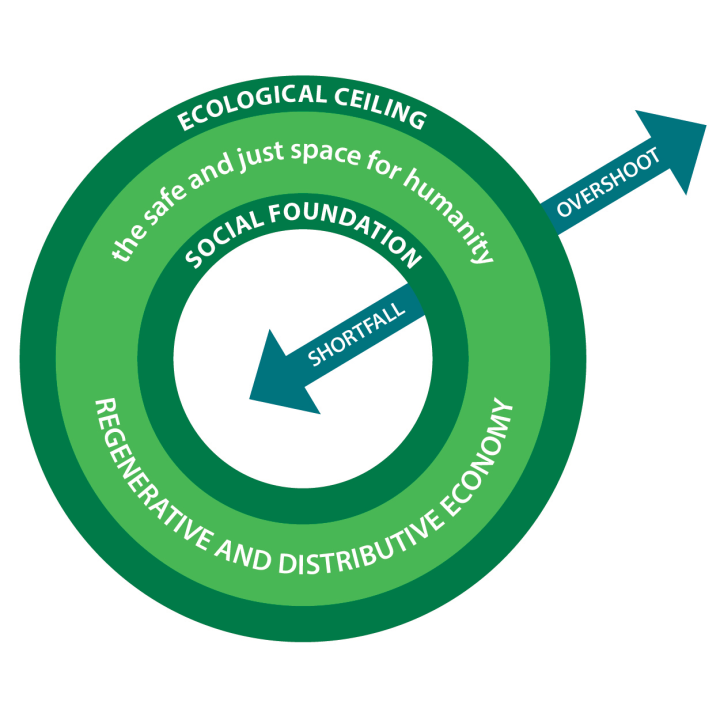
If our economic system is not capable of providing a social foundation for every layer of society, then it goes into a shortfall. It simply means that some citizens of a country are left behind and lack basic humanitery needs even though the country might grow in terms of GDP. On the other hand, while assuring a solid economic growth, we might end up overshooting our ecological limits. This can cause pollution in our cities, biodiversity loss, and inequality. Of course, it’s not only black or white, so you might wonder what is between those circles, and you would find out what Kate Raworth calls a “sweet spot” for our society. In theory, there must be a safe zone where both people and the planet can thrive. Essentially, our economies should aim to be 21st-century models that leave no one behind and keep our planet intact.
Key Principles of Doughnut Economics
Doughnut Economics is founded on the principle that growth alone cannot be the sole measure of prosperity. Instead, it asks a more fundamental question: are we meeting the essential needs of people while staying within the limits of our planet? At the heart of this approach lies the call to move beyond GDP as the sole benchmark of success and to focus on human well-being and ecological balance. The framework encourages a regenerative economy, which is one that works with nature, not against it. It’s about restoring resources rather than depleting them. It also emphasizes distributive design, ensuring that wealth, power, and opportunities are more fairly shared across society instead of concentrated in the hands of a few. Taken together, these principles shift the role of economics from maximizing short-term profits to building long-term systems where communities and ecosystems can thrive together.
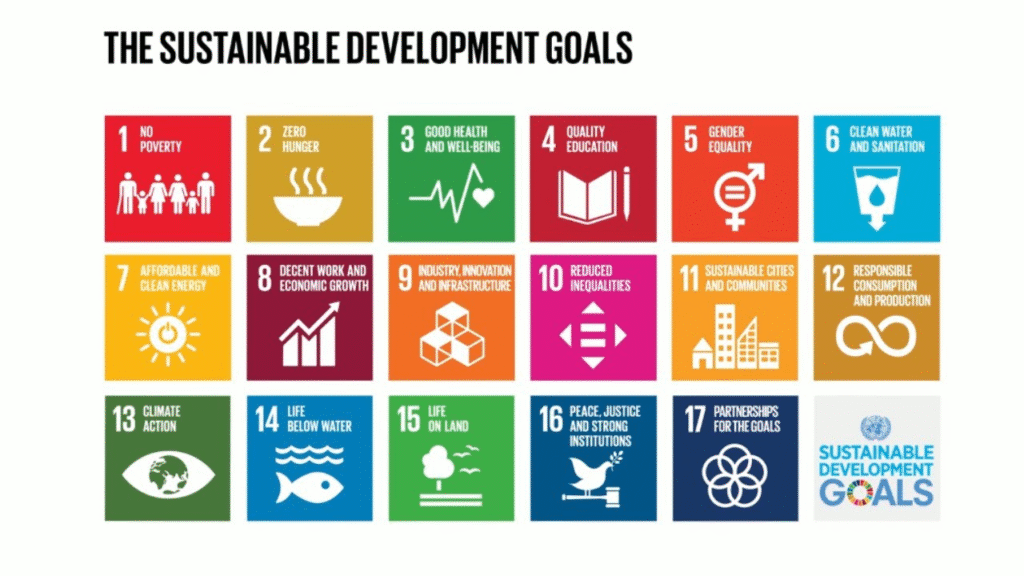
The social foundations of Doughnut economics are inspired by the United Nations’ Sustainable Development Goals.
Criticism and Limitations
While the Doughnut Theory has gained global attention, it is not without criticism. Some economists argue that it functions more as a vision than as a practical roadmap, pointing out the difficulties in translating its broad ideals into measurable policies. Others highlight the challenge of implementation: how can governments accustomed to GDP targets adopt indicators that capture social well-being and ecological health in a reliable way? Additionally, skeptics question whether businesses will genuinely embrace regenerative and distributive practices without stronger incentives or regulation. These critiques do not diminish the value of the framework, but they do underline an important truth: the Doughnut economics is not a ready-made solution, but rather a guiding compass. Its strength lies in sparking debate and inspiring action toward an economy that serves both people and the planet, even if the journey toward that goal remains complex and unfinished.
You can check related articles in my blog by clicking here and here.
sources
Raworth, K. (2017). Doughnut Economics: Seven Ways to Think Like a 21st-Century Economist.
Hasanov, R., & Azizli, N. (2025). Doughnut Economics: Exploring a New Alternative Sustainable Model. Economic Alternatives. https://doi.org/10.37075/ea.2025.1.08.

