

Once more, that enchanted season has arrived. Additionally, we are just a few days away from wearing goofy Christmas sweaters and receiving Christmas presents. The excitement in the air is even odorous. Christmas is the greatest time of year for the majority of people, including me. Perhaps you share this opinion as well. The good news is that I also wrote a piece about some lovely vintage Christmas films. The article can be found by clicking this link.
In this article I will be explaining the effects of Christmas on the markets and overall economy. It is very sensible to assume that the amount of consumed goods will increase in the holiday season. But there might be something more about the Christmas magic in the economy. As most of you can guess, important holidays affect travel ticket prices, most significantly airline ticket prices. This can be explained with the rising demand for airline tickets because most of the people want to travel to their home countries, cities, etc., during the holiday seasons.
Deadweight Loss in Christmas
In economics there is a phenomenon called deadweight loss. And it is a loss of societal economic welfare where marginal benefit (to society) does not equal marginal cost. Basically, deadweight loss is net benefit that is missed out on. And it can also be used as a measure of loss in economic efficiency when the optimal amount of goods and services is not being produced or consumed.
Economists have argued whether giving Christmas gifts to your beloved ones is a waste of resources for years now. One study showed that when people receive gifts, they wouldn’t like to buy the same gift for themselves or wouldn’t pay the same price for it. For example, if you got a sweater as a gift that costs 100 dollars, but you would only pay 50 dollars for it if you were buying it yourself. So, a 50 dollar difference is the welfare loss. If you don’t wear it even once, then the loss goes up to 100 dollars. The amount of welfare loss in giving/receiving holiday gifts depends on very diverse factors. Some studies showed that the minimum waste is when the gift buyer is a close friend of the recipient.
Santa Rally in the Stock Markets
The Santa Claus Rally defines a huge short-term increase in stock markets before the Christmas holiday. This effect took place in economic literature after the 1972 Stock Trader’s Almanac. Although there is no agreed reason for the Santa Claus rally in the markets, a lot of economists assume there must be some reasons for this phenomenon to occur. Some believe it is about the optimism for the next year or just increasing demand with the holiday spending. Some say it cannot be persistent according to economic laws because acknowledged investors exploit this effect, and it would disappear as quickly as it appears. Because, according to the Efficient Market Hypothesis, it is impossible to beat markets. Yet this effect usually works in many stock markets around the world. But in countries where Christmas is not a holiday, this might change.
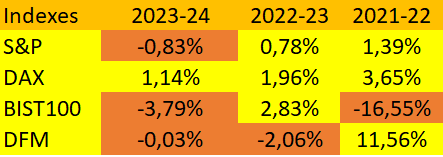
I took two indexes from countries where Christmas is celebrated and two countries that do not. As you can see on the table above, the Santa Rally happens in countries where Christmas is a holiday. However, in other countries the results are not stable in different years. BIST100 (Türkiye) and DFM (United Arab Emirates) indexes haven’t shown any consistent increase during the Christmas time in the last 3 years. On the other hand, DAX (Germany) has shown a consistent increase during the Christmas time in the last 3 years.
Christmas Effect on Jobs and Growth
Studies in the labor market during the Christmas season showed that work hours and wages are higher than the rest of the year. But in the economic growth side, results are mixed and not clear. There is another phenomenon called the “Santa Claus Effect in Business Cycles” that says there must be an economic boom in the fourth quarter of the year. This effect was tested by different economists, and they found an economic boom in the fourth quarter in only seven out of fifteen countries. And another study showed negative effects on the economy during the religious holidays.
In conclusion, Christmas has positive effects on employment, but there are no certain results for the economic boom or long-term growth. But further research in these is needed.
Conclusion
It is hundred percent true that Christmas gives the best vibes and gives us a special time with our beloved ones and sometimes teaches life lessons from the religious or old stories. Other studies about Christmas showed that:
- Alcohol consumption during Christmas increases and might be problematic for nearly all countries in the world.
- Global suicide rates are usually low during Christmas. The probability of conception will increase at Christmas with an increase in birth rates in September.
- Having wish lists for the Christmas present might be helpful to prevent the possibility of deadweight loss in the economy.
sources
Birg, L. and Goeddeke, A. (2016), CHRISTMAS ECONOMICS—A SLEIGH RIDE. Econ Inq, 54: 1980-1984.
Mulligan, C. (2010). Does Labor Supply Matter During a Recession? Evidence from the Seasonal Cycle. https://doi.org/10.3386/w16357
Hylleberg, S., J�Rgensen, C., & S�Rensen, N. K. (1993). Seasonality in macroeconomic time series. Empirical Economics, 18(2), 321–335. https://doi.org/10.1007/bf01205406
Holidays and the economic growth of nations Munich Personal RePEc Archive. (n.d.). https://mpra.ub.uni-muenchen.de/id/eprint/17326

