Just a couple of days ago, the winners of the Nobel Prize of 2024 were announced. Daron Acemoglu is one of them, and he is today’s subject. It is a huge and prestigious award for scientific research globally. Starting from the year 1901, every year laureates are announced in six fields. Those are physics, chemistry, physiology or medicine, literature, peace, and economic sciences, by the will of Swedish inventor Alfred Nobel. The reason for such an award is to present it to those who gave outstanding efforts for the benefit of humankind. The Nobel Foundation is the responsible organization for this initiative.
We are going to focus on awards in this year’s economic sciences field. Actually, the laureates of this year were no surprise. Especially Turkish economist Daron Acemoglu has been known for his outstanding research about economic prosperity and development. Also, he and one of the other laureates, Simon Johnson, are colleagues at the Massachusetts Institute of Technology (MIT). Daron Acemoglu once stated that he was interested in economics in his teenage years and grew a passion for it; later on, he found another “lost soul” that could work together in his beloved interest. This year’s award is given for their insights into why there are such vast differences in prosperity between nations. One important explanation is persistent differences in societal institutions.
Why Are Some Countries Rich and Others Poor?
The research showed that the richest 20 percent of the world’s countries are now around 30 times richer than the poorest 20 percent. So what is the reason for that, and why can the poorest countries not catch up to the most prosperous ones? So, these scientists have found convincing evidence for this persistent gap: differences in a society’s institutions. It’s not easy to prove this point. Just because there’s a correlation between a society’s institutions and its prosperity doesn’t mean one necessarily causes the other. Wealthy countries differ from poorer ones in many ways—not just in their institutions—so there could be other factors driving both their prosperity and their institutions. It’s also possible that prosperity influences a society’s institutions rather than the other way around. To address this, the laureates took an innovative empirical approach to find their answer.
Another outcome of the research is that some countries are stuck in a trap with “extractive institutions,” and escaping from this trap is so difficult. To be clear, extractive institutions mean the systems, structures, or policies designed to extract wealth and resources from the majority of the population for the benefit of a small elite group. These institutions often lack inclusive political representation and economic opportunities for the general public, leading to inequality and underdevelopment. However, there is also a chance for poor countries to change this situation and form new institutions. In certain situations, a nation can achieve democracy and the rule of law by shedding its inherited institutions. Over time, these adjustments also result in less poverty.
An Example of Two Cities
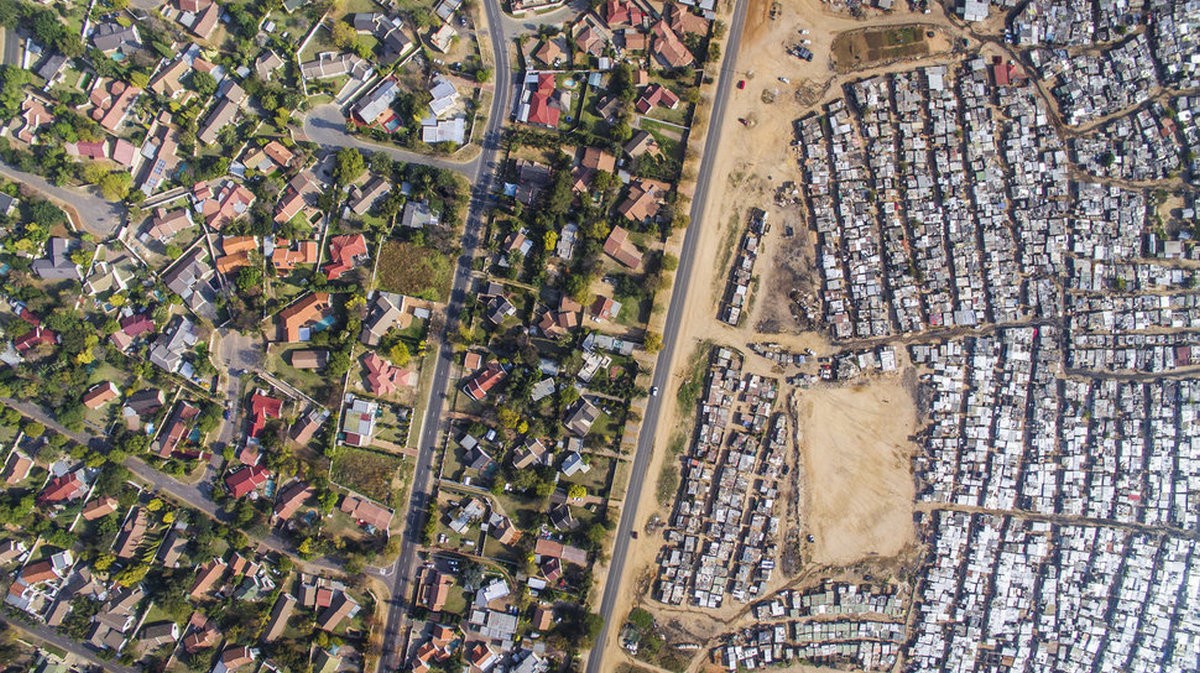
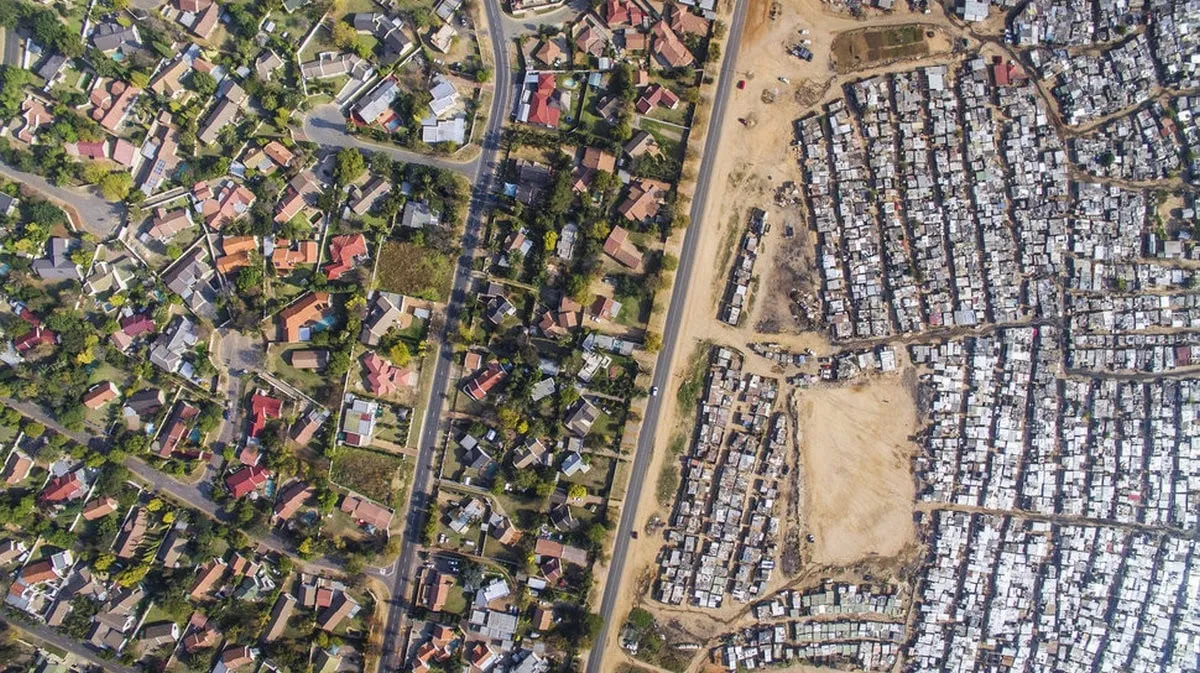
Daron Acemoglu and James A. Robinson’s work called Why Nations Fail gives an example of two cities. The area called Nogales is located between two countries, the United States and Mexico, and it is cut in half by a fence. The northern part of Nogales’s residents have long average lifespans, and most children receive high school diplomas. And free elections provide residents with the opportunity to replace politicians with whom they’re not satisfied.
And if you look at the south part of Nogales, in Mexico, the residents here are generally poorer than on the north side of the fence. Organized crime makes it risky to start businesses. And corrupt politicians are difficult to remove because of the imperfect democratic system. So the question is this: why do these two halves of the same city have such different living conditions? There is no difference in the geography, natural sources, or climate. And two populations have similar origins historically. People eat similar food and listen to the same kind of music on both sides of the fence.
According to the authors, the answer is in the institutions. The people of the USA’s side of the city are part of a stronger economic system that provides broader opportunities. And in the south part of the fence, residents are not as fortunate. Because Mexico has a weaker economic structure and not a fully trusted political system.
Early Theories
This year’s laureates have contributed a fresh dimension to earlier explanations for the existing disparities in wealth across the world. One of these concerns geography and climate. Since the publication of Islamic philosopher Ibn Khaldun’s classic work Muqaddimah (1377), it has been widely accepted that nations in more temperate climate zones are more economically productive than those in the tropics. There is a correlation: countries closer to the equator are poorer. However, the laureates argue that this is attributable to more than just the climate. If that were true, the massive reversal of fortune would not have happened. Instead, societal institutions play a key role in explaining why hotter countries are also poorer.
Even some theories claim that the prosperity of nations comes from natural sources, but in modern economic consensus, this is not always true.

“Throughout history many nations have suffered a physical defeat, but that has never marked the end of a nation. But when a nation has become the victim of a psychological defeat, then that marks the end of a nation.”
— Ibn Khaldun
What Can We Learn About These Researches?
Daron Acemoglu, Johnson, and Robinson identified a clear chain of causality. Institutions designed to exploit the public are detrimental to long-term progress, whereas those that establish fundamental economic liberties and the rule of law are beneficial. Political and economic institutions are also known for their extended lifespans. Even if extractive economic systems generate short-term rewards for the ruling class, the implementation of more inclusive institutions, less extraction, and the rule of law would result in long-term benefits for all.
Their findings on how institutions influence prosperity suggest that working to foster democracy and inclusive institutions is a crucial step forward in the promotion of economic development. These organizations promote economic development by promoting investment, fostering wide involvement, and leveraging market power. So, the solution is right in front of us. From the colonial past to the present, inclusive social and economic structures must be built and protected in order to generate prosperity.
Long-term study has also shown that autocratic administrations can raise growth quickly, but it is difficult to sustain. “Democracies are going through a rough patch,” Acemoglu stated. “And it is in some sense quite crucial that they reclaim the high ground of better governance, cleaner governance, and delivering sort of the promise of democracy to a broad range of people.” Please check out the sources of this article for further reading and more of the studies of Daron Acemoglu.
In writing this essay, various AI tools were utilized to enhance research, improve clarity, and streamline the overall composition.